
TikTok AI agents, Meta search shift, social data gap
Social data gaps, TikTok AI agents, Meta's search shift, and the science of expressive selling, your weekly marketing digest from Donutz Digital.
 Carla9 June 202610 min read
Hey there 👋
Another week, another round of platforms quietly reshaping the rules while marketers are still finishing their Monday morning coffee. This issue covers AI agents taking over ad dashboards, the science of why your sales team needs to gesture more, Meta’s case that Google is losing the discovery race, and a stat about social data that should make every CMO slightly uncomfortable.
TikTok just handed your media buyer to a robot 🤖
TikTok has launched an MCP server that lets third-party AI agents run full ad campaigns autonomously, directly inside TikTok Ads Manager, with no human in the loop.
At TikTok World, its annual marketing showcase, the platform announced that external AI agents can now connect directly to its advertising infrastructure through a Model Context Protocol (MCP) server. The practical implication is significant: AI tools plugged into this system can handle every core campaign operation, from setting bids and shifting budgets, to adjusting audience targeting and generating ad creatives, without a media buyer ever touching the dashboard.
Jose Villalobos, TikTok’s global head of product marketing for platform and core ads, framed it as enabling marketers to connect their own AI systems directly to the platform so campaigns can plan, launch, and optimize autonomously. Developers can also build custom infrastructure tailored to specific advertiser workflows through third-party API agents designed for AI interoperability. At launch, Google Analytics is the first supported third-party optimization integration.
This puts TikTok in line with the rest of the industry. Meta, Google, and Amazon Ads have all built similar MCP-based layers over the past year. TikTok was actually the last of the four major platforms to ship this infrastructure. The convergence means that for large advertisers, the question is no longer whether to use AI agents to manage campaigns, but which ones to trust with your budget, and how tightly to supervise them.
For marketing directors, the implications go beyond efficiency. As campaign execution gets delegated to AI systems, the competitive edge shifts upstream: to strategy, creative direction, and how well your AI stack is configured and supervised. The platforms are building the pipes. What flows through them is still up to you.
Your arms are a conversion tool. Use them.
Research on 847 participants across 14 sales pitches found that expressive salespeople, using energetic vocal delivery and active body language, generated purchase intent up to 36% higher than their more subdued counterparts.
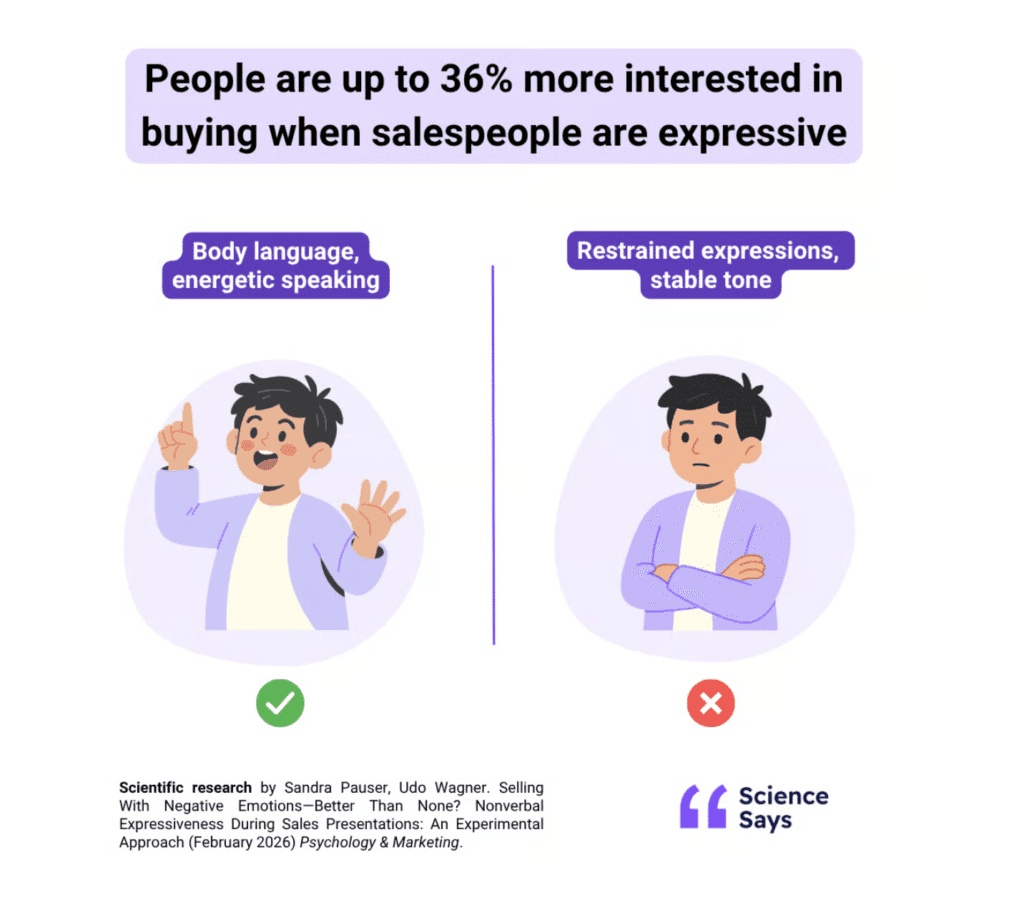
A study from the University of Vienna and Modul University Vienna, published in Psychology & Marketing in February 2026, set out to quantify what most people intuitively suspect: being expressive in a sales context actually moves the needle. The results are more concrete than expected.
Compared to low-expressiveness presenters, high-expressiveness salespeople saw products rated nearly 32% more positively, purchase willingness jump by approximately 36%, and charisma scores more than double. The drivers are largely non-verbal: voice energy, arm movements, direct eye contact, and facial expressiveness all contribute.
There are nuances worth knowing. The effect is strongest for emotionally driven or pleasure-oriented products like fashion, travel, or lifestyle goods. For practical, problem-solving categories like tax software or pest control, the boost is smaller. And if expressiveness tips into visible frustration or mild anger (say, disparaging a competitor’s product), the charisma read actually reverses: calm, controlled delivery outperforms in those moments.
The practical read for marketing and sales leaders is fairly direct. If your team is presenting, pitching, or appearing in video content, expressiveness is not a personality trait to tolerate or suppress. It is a performance variable with measurable commercial impact. That applies equally to internal sales training, external brand spokesperson selection, and even the energy of your brand’s video ad creative.
If your team’s pitch decks are solid but the delivery is flat, the slides are not the problem.
Meta says Google is losing the discovery race
Meta published a three-part research series arguing that social platforms have displaced traditional search as the primary channel where consumers discover new products, with Google searches per US user down nearly 20% year over year.
The series, anchored by a 16-page report drawing on multiple consumer surveys, makes a case that deserves attention from any marketer still allocating the majority of their discovery budget to search. The core argument is that consumers have not stopped asking questions; they have changed where they go to find answers. And increasingly, that place is social.
The shift is driven by a few overlapping trends. Short-form video has merged entertainment and information in a single scroll. Creators and user-generated content surface product context in ways that editorial search results rarely do. And social platforms now host both intent-driven search behavior (users actively looking for something) and passive discovery (users stumbling across something relevant), whereas Google has historically dominated only the former.
Meta is transparent about its vested interest here, but the underlying data on search volume decline aligns with trends independently documented elsewhere. The series is also a roadmap for how Meta plans to capitalize: by positioning its AI tools as the layer that connects these two discovery modes and converts attention into purchase action.
For CMOs, the strategic question is whether your content architecture is built for one search mode or both. Most brands are still producing content optimized for keyword intent. The social discovery shift rewards content that entertains first and converts second.
93% say social data matters. Only 14% actually use it well. 📊
A Sprout Social study of 705 social media professionals found a striking gap: nearly all respondents consider social data collection important for growth, but a small fraction feel their organization is genuinely using it to its full potential.
The report, titled “The Intelligence Gap,” surveyed professionals across the US, UK, and Australia in early 2026. The headline tension is hard to ignore: 93% of respondents view social intelligence as strategically important, but only 14% feel their organization is actually equipped to use it properly. Just 36% said social data regularly informs decisions outside of the marketing department.
The consequences of this gap are concrete. A third of respondents said their organization missed significant cultural shifts in the past one to two years because consumer insights were misread or ignored. Thirty-one percent said they failed to catch early signals of shifting consumer preferences. A quarter escalated customer issues that social data could have flagged and resolved earlier.
The structural problem is not a shortage of data. Social platforms generate an enormous volume of consumer signal in real time. The bottleneck is organizational: siloed teams, unclear ownership of social intelligence, and a persistent tendency to treat social media as a communications function rather than a data source. Only 6% of organizations described social intelligence as a shared cross-departmental responsibility.
Sprout Social’s vice president of social intelligence summed up the issue as a translation problem, not a measurement one. The data exists. The difficulty is making it legible and actionable across functions that do not speak the same language as social teams.
That’s a wrap
Four stories this week, one common thread: the gap between having the right tools and actually deploying them well is where most marketing organizations are leaving performance on the table.
If you’re looking at any of this and wondering where to start, that’s exactly what we do at Donutz Digital. We help growth-focused businesses turn digital marketing infrastructure into results. From paid social and SEA strategy to analytics and creative execution, let’s talk about what’s holding your funnel back.
See you next week.
Ready to grow your digital marketing?
Get a free audit from our experts — no commitment.