
Low-hanging fruit SEO: how to find and capture quick ranking wins
How to find keywords you already rank for in positions 5–20 with Google Search Console, and the quick changes that move them up: titles, content, internal links and technical basics.
 MJ3 July 20238 min read
Not every SEO win requires months of link building or a new content strategy. Some of the fastest gains come from pages and keywords you already rank for, just not quite high enough. These are your “low-hanging fruit”: small, targeted improvements that can move a page from the bottom of page one (or the top of page two) into the positions that actually get clicks.
What are low-hanging fruit SEO opportunities?
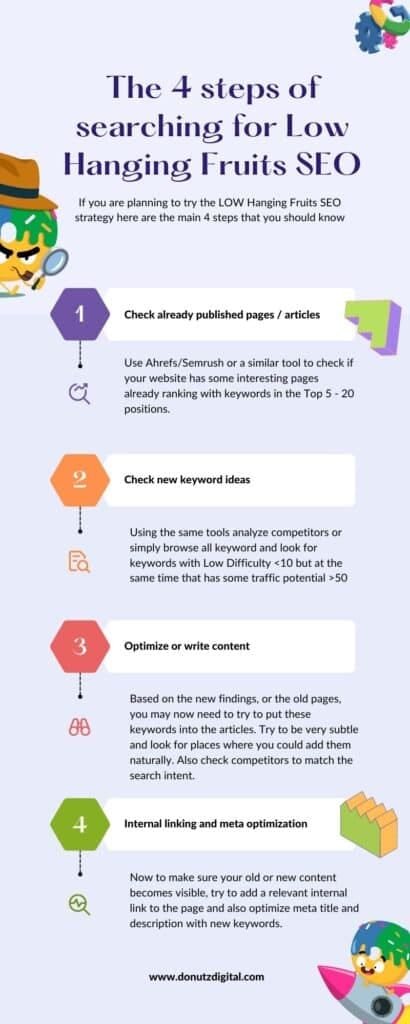
A low-hanging fruit is a keyword where your site already has some visibility, typically ranking between positions 5 and 20, with real search demand behind it. Because Google already considers your page relevant, a modest improvement to the content, the title or the internal links is often enough to climb a few positions.
This is very different from targeting new keywords from scratch. You are not convincing Google that your page is relevant; you are giving it a reason to rank you a little higher.
Why focus on them first?
- Faster results: improving an existing page usually shows results within weeks, not months.
- Bigger impact per position: moving from position 9 to position 4 can multiply clicks, because click-through rates drop sharply as you go down the page.
- Lower effort: you are editing pages that already exist and already have some authority.
- Proof for the bigger plan: quick wins help justify investment in longer-term SEO work.
How to find your low-hanging fruit
1. Start with Google Search Console
Google Search Console is the best free source, because it shows your real queries, impressions, clicks and average position. In the Performance report:
- Select the last 3 months and display impressions, clicks, CTR and average position.
- Filter queries with an average position between 5 and 20.
- Sort by impressions: the queries at the top have real demand and are within reach.
- Look for pages with high impressions but a low CTR: their title and meta description probably need work.
2. Cross-check with an SEO tool
Tools such as Ahrefs or Semrush add keyword difficulty, estimated volume and competitor data. Filter your organic keywords by position (for example 4 to 15) and low difficulty to spot the easiest wins. See our comparison of affordable SEO tools if you need one.

3. Prioritise
Score each opportunity on three criteria: search demand, current position and business value. A keyword at position 8 with high commercial intent is worth more than a keyword at position 6 that never converts.
How to capture them
Rewrite titles and meta descriptions
If a page has plenty of impressions but few clicks, start here. Put the main query near the start of the title, make the benefit clear and write a meta description that answers the searcher’s intent. It is the fastest change you can make.
Improve and update the content
Compare your page with the pages ranking above it. What questions do they answer that you do not? Add missing sections, update outdated information and figures, add an FAQ where relevant, and remove or merge thin and duplicate content.
Strengthen internal linking
Internal links tell Google which pages matter most and pass authority between pages. Link to your target page from related, well-performing pages, using descriptive anchor text that reflects the query you want to rank for.
Fix the technical basics
Make sure the page is indexed, loads quickly, works well on mobile and uses clean, descriptive URLs. Changing an existing URL is rarely worth it, though: if you do, set up a 301 redirect.
Think beyond the blue links
Google now shows AI Overviews on many queries. Clear, well-structured answers, up-to-date facts and visible expertise also make your page more likely to be cited there, which is becoming a quick win of its own.
Measure the results
Note the date of each change and compare positions, impressions, clicks and CTR in Search Console 4 to 8 weeks later. Keep what works and roll the same approach out to similar pages.
FAQ
How long does it take to see results?
Title and meta description changes can show an effect within a few weeks once Google recrawls the page. Content improvements usually take 4 to 8 weeks to be fully reflected in rankings.
Can I find low-hanging fruit without paid tools?
Yes. Google Search Console alone is enough to identify queries in positions 5 to 20 with high impressions, which is the core of the method.
What if a page does not move after an update?
Check whether the search intent matches your page: if the pages ranking above you are a different type of content (comparisons, product pages, guides), you may need a different page rather than more text.
Want experts to capture these quick wins for you? Explore our affordable SEO services.
Ready to grow your digital marketing?
Get a free audit from our experts — no commitment.