How does Google Ads work? The complete beginner’s guide
Formats, auctions and Quality Score, costs, Performance Max, what is new in 2026, best practices and agencies: the complete guide to understanding Google Ads and getting started.
 Carla17 November 202610 min read
You want to win new customers online, and Google Ads comes up in every conversation. But how does it actually work, what does it cost, and should you get help? This guide explains Google Ads from the advertiser’s point of view: its formats, how it works, its strengths and limits, and what is new in 2026.
Why Google Ads?
Without Google, finding customers means relying on your network, trade press, prospecting or social media, and hoping to reach someone at the right moment. With Google, customers tell you what they need: every day, millions of people search for a product, a service or a solution to a problem. In most European markets, Google handles the large majority of searches.
Being visible at the exact moment someone looks for what you sell: that is the whole promise of Google Ads.
SEO or Google Ads: how to show up at the top of Google
SEO gets you into the results for free, but it takes time, content and technical work, and the top spots are fiercely contested. AI-generated answers (AI Overviews and AI Mode) are also reducing the space left for traditional links.
Google Ads puts you at the top of the page straight away, on the searches you choose. The two work together: Google Ads delivers results from day one, SEO builds lasting visibility.
Google Ads formats
Search ads
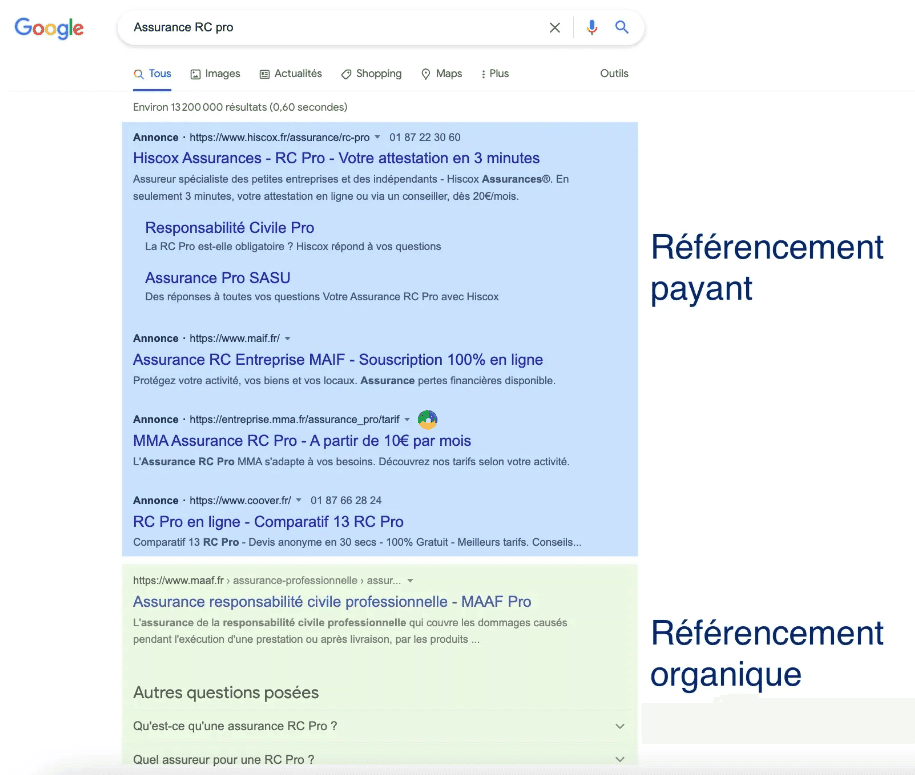
The original and most widely used format: a text ad shown at the top (or bottom) of search results, labelled “Sponsored”. You choose the keywords you want to appear for and pay when someone clicks.
Shopping ads
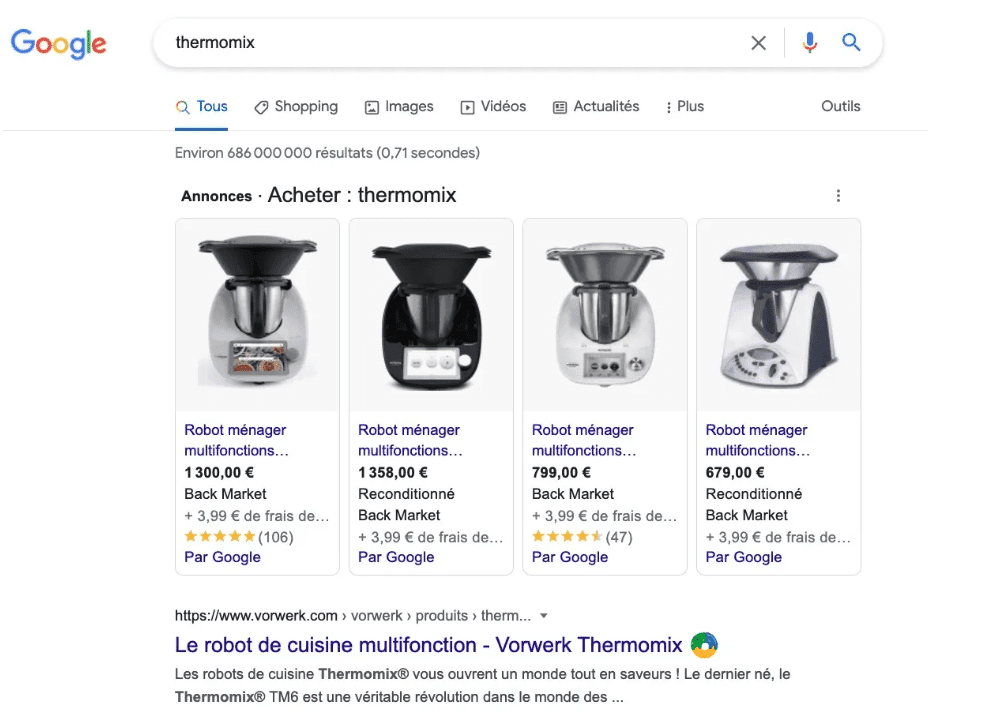
For e-commerce: a product listing with a photo, price and store name, generated from your product feed in Google Merchant Center. In Europe, these ads can also be run through partners called CSSs (Comparison Shopping Services).
YouTube ads
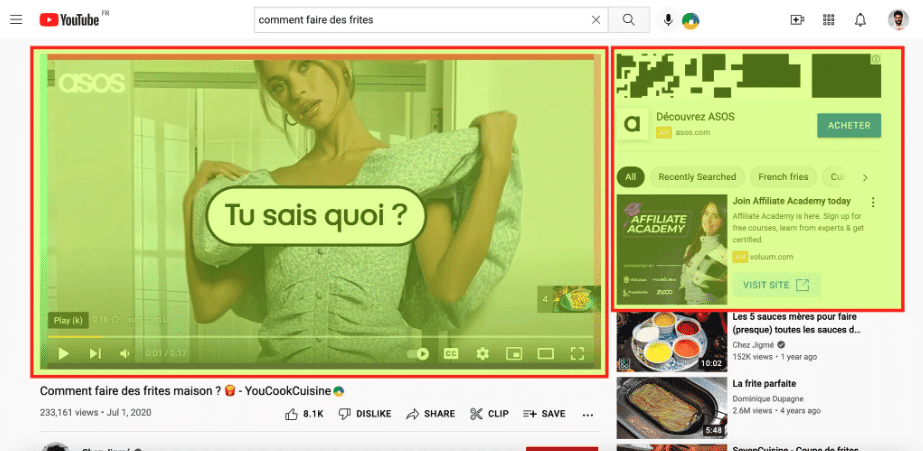
Videos shown before, during or alongside YouTube content, including Shorts. Once reserved for big brands, the format has become accessible thanks to easier video production tools. For conversions, it now runs through Demand Gen campaigns.
The Display Network
Banners shown on millions of Google partner sites and apps. Display is mainly useful for awareness and remarketing (re-engaging people who visited your site). It needs care: site quality varies, placements must be monitored, and Display should rarely be judged on direct cost per conversion alone.
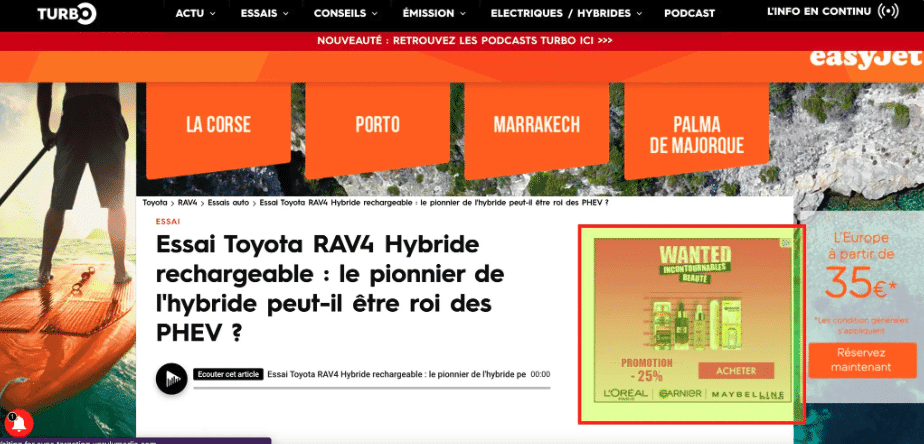
Performance Max and Demand Gen
Performance Max is an all-in-one campaign: based on your goals, images, copy and (for e-commerce) product feed, Google’s AI serves your ads across all its networks (Search, Shopping, YouTube, Display, Discover, Gmail, Maps) and sets bids itself. Powerful, but long criticised for its lack of transparency, it has opened up since 2025 with search term and channel reports. See Performance Max in 2026.
Demand Gen is designed to create demand with visual formats on YouTube, Discover and Gmail. It replaced Video Action and Discovery campaigns.
How does Google Ads work?
An auction… but not just to the highest bidder
For every search, Google runs an auction between the advertisers targeting that query. Contrary to popular belief, the highest bid does not automatically win: Google calculates an Ad Rank that combines your bid, the quality of your ad and landing page (your Quality Score), your ad assets and the context of the search.
As a result, a highly relevant ad can outrank a competitor with a higher bid, and pay less. It is in Google’s interest: an ad nobody clicks earns it nothing.
You pay per click
On Search, you usually pay per click (CPC): impressions are free, you only pay when someone visits your site. You stay in control with an average daily budget, which Google may exceed on some days but not beyond the monthly equivalent.
Automated bidding (Smart Bidding)
Behind each bid, hundreds of signals come into play: device, location, time of day, browsing history, audiences… Automated bid strategies (maximise conversions, target CPA, target ROAS) use these signals to adjust the bid for every search. They work well, on one condition: reliable conversion tracking, without which the algorithm is optimising blind.
How much does Google Ads cost?
There is no minimum: you set your budget. Cost per click ranges from a few cents to tens of euros depending on how competitive your sector is. The right question is not “how much does it cost” but “how much is a customer worth to me”: that determines the acquisition cost you can afford.
What is new in 2026
- AI Max for Search: an option for Search campaigns that expands your keyword reach and adapts ads using AI.
- Ads in AI answers: already shown in AI Overviews and AI Mode in the US and several English-speaking countries, not yet in most of Europe. See how to adapt your Google Ads to AI answers.
- Consent Mode v2, required in Europe to make full use of remarketing and measurement.
- More transparency in Performance Max, with search term and channel reports.
Best practices to get started
- Set a measurable goal: sales, quote requests, calls.
- Set up conversion tracking before launching any campaign.
- Start with Search on your highest-intent queries before expanding.
- Write specific ads and take care of the landing page: that is what turns a click into a customer.
- Review search terms every week and add negative keywords.
Manage Google Ads yourself or with an agency?
You can absolutely start on your own, especially with a small budget and a simple goal. An agency becomes worthwhile as the stakes grow:
- Experience: an agency sees dozens of accounts and sectors, and transfers what works from one to another.
- Keeping up: Google Ads changes constantly, and following every update takes time.
- A critical eye on Google’s recommendations: automation is powerful but generic. Google reasons as if your budget were unlimited; you have margin, stock and seasonality constraints.
- Beyond the ads: tracking, data, landing pages, conversion… performance is also won outside the Google Ads interface.
How do agencies charge?
- Flat fee: a fixed monthly amount.
- Percentage of ad spend: often between 10% and 20%, depending on budget.
- Hybrid: a fixed part plus a variable part.
- Performance-based: a fee linked to the revenue or margin generated.
No model is better in absolute terms: it depends on your budget and goals. Our article on Google Ads agency pricing gives typical ranges.
How to choose
Check Google’s official Partners directory, client reviews and your own network. A free audit is useful for a first diagnosis, but a real strategy deserves an in-depth audit. And before you sign, ask to meet the person who will actually manage your account, not just the salesperson. All our advice is in our guide on how to choose a Google Ads agency.
Learning Google Ads
- Google Skillshop: official, free training and certifications.
- Grow with Google: free courses on digital marketing basics.
- HubSpot Academy: free courses, including an introduction to Google Ads.
FAQ
What is the minimum budget for Google Ads?
There is no imposed minimum. In practice, plan a budget that brings enough clicks, and ideally a few dozen conversions a month, for the data to be usable.
How long before I see results?
The first visits arrive as soon as your ads go live. It usually takes a few weeks for automated bidding to learn and for you to have enough data to optimise.
Does Google Ads improve my organic rankings?
No, paying for Google Ads does not directly improve your SEO. However, campaign data (keywords that convert, messages that work) is valuable for your content strategy.
What is the difference between Google Ads and Google AdWords?
None: Google AdWords was renamed Google Ads in 2018, to reflect the platform’s expansion beyond keywords (YouTube, Display, Shopping…).
Want experts to run your campaigns? Discover our Google Ads agency.
Ready to grow your digital marketing?
Get a free audit from our experts — no commitment.