Hey there, marketing maverick 👋
While you were busy optimizing last quarter’s campaigns, the marketing landscape did its thing again: shifted dramatically. This week we’re diving into research that explains why your customers ghost you, why your job might be evolving faster than you think, and how LinkedIn accidentally became AI’s favorite source material.
Grab your coffee ☕ and let’s get into it.
The Customer Confidence Paradox: Why They Leave After Buying Three Times
New research from Northwestern, Penn, and Arizona State just cracked a mystery that’s been haunting e-commerce managers everywhere: why do customers churn after multiple purchases instead of after the first one?
Turns out, confidence follows a U-shaped curve. When customers first try your product category, they’re blissfully overconfident because they don’t know what they don’t know. After trying a few variations, say, three or four products, they suddenly realize their knowledge gaps. This uncertainty makes them bolt to competitors. But if they stick around long enough to become category experts, their confidence rebounds and brand loyalty locks in.
The numbers are stark: customers who’ve reviewed between two and ten products are nearly five percent more likely to switch brands. In makeup, a staggering fifty-four percent of switchers never return. In wine, the danger zone sits between ten and two hundred forty wines tried. For beer, it’s after eight different brands.
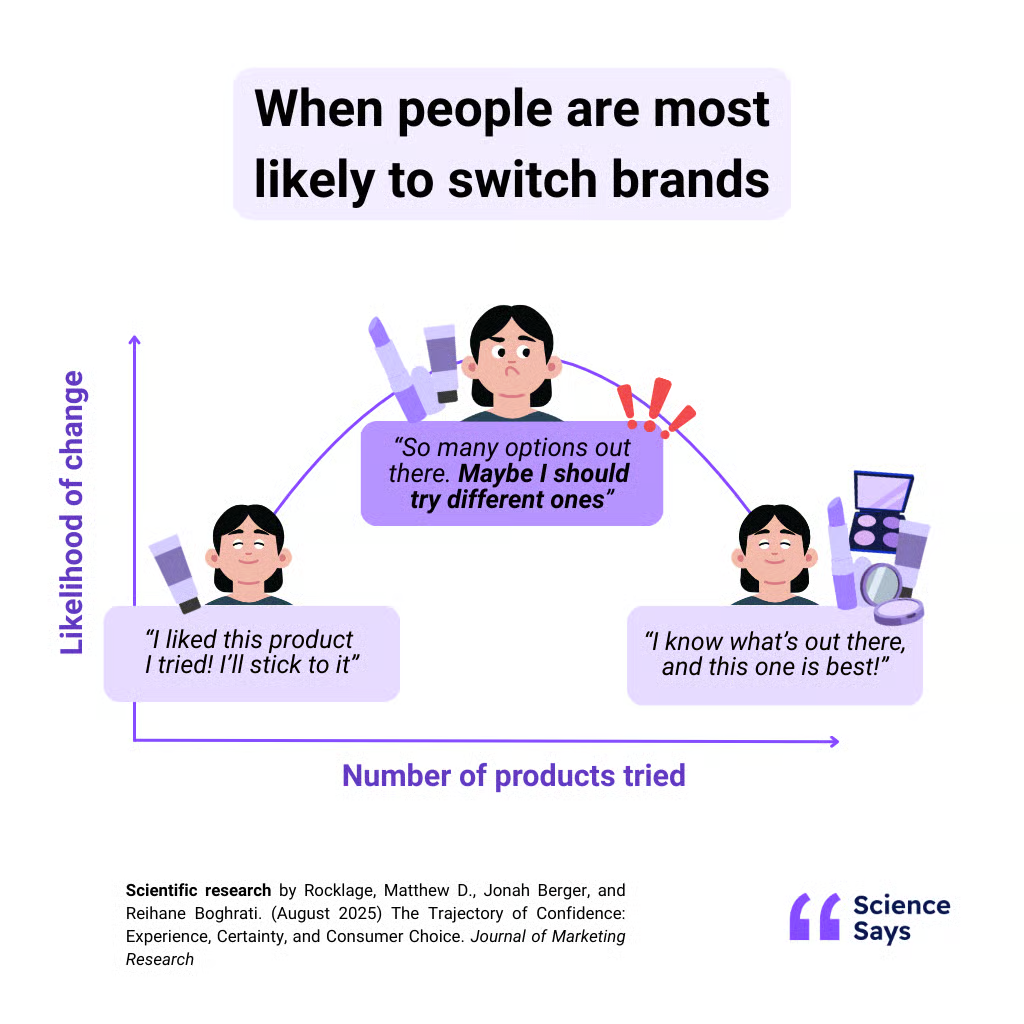
Why does this happen? Psychologically, we’re victims of the Dunning-Kruger effect in reverse. Initial inexperience breeds false confidence. Then experience reveals complexity, triggering uncertainty and brand-switching behavior. Only deep expertise restores decision confidence.
The solution isn’t rocket science, but it does require strategic thinking. Monitor customer experience levels through purchase history. For those in the danger zone, medium experience but not yet experts, engage them differently. Send feedback surveys that prompt reflection on product quality. Avoid recommending identical products; instead, diversify suggestions to satisfy their exploration urge while keeping them in your ecosystem. Most importantly, encourage thoughtful evaluation of their experience, which accelerates the journey to confident expertise.
The takeaway? Your churn problem might actually be a confidence problem. And confidence is something you can actively build.
Need help reducing customer churn with data-driven strategies? Let’s talk.
65% of Marketing Jobs Won’t Survive AI (And What That Means for You)
If you felt a chill run down your spine reading that headline, you’re not alone. Anthropic just dropped a labor market analysis that ranks marketing specialists fifth among eight hundred occupations most exposed to AI displacement, right behind programmers and customer service reps.
Marketing professor Mark Ritson breaks down why marketing is uniquely vulnerable. First, our work is language-heavy. Everything we produce, strategies, briefs, reports, decks, is text, and large language models devour text for breakfast. Second, marketing sits at the intersection of creativity and process, offering enough structure to be codifiable yet enough ambiguity for AI’s probabilistic pattern-matching to excel. Third, marketing departments have been chronically under-resourced, making AI an attractive solution to CFOs looking to trim budgets. Fourth, many marketers lack formal training, producing sub-optimal work easily superseded by trained algorithms.
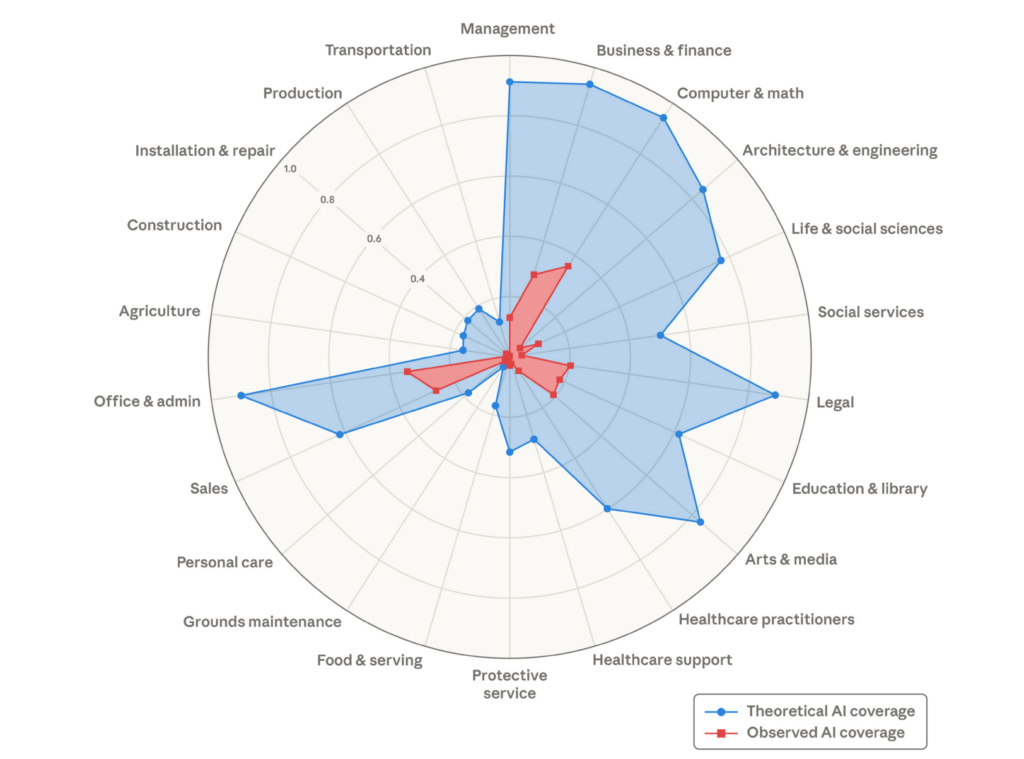
The displacement isn’t happening overnight, it’s a slow structural constriction playing out across a decade. It starts with hiring freezes. Marketing job postings in the US dropped seven percent year-over-year and fifteen percent quarter-over-quarter in Q2 2025. When available roles dry up, people stop leaving their current positions. The US voluntary quit rate has plummeted to two percent, the lowest in a decade. Less movement means positions go unfilled, and organizations discover they didn’t need those roles anyway. Nearly a quarter of marketing businesses cut senior leaders last year without replacing them.
What’s particularly disturbing: the impact disproportionately affects younger, more educated, early-career workers. Senior marketers with institutional knowledge and client relationships are harder to replace. Junior analysts who synthesize research and build decks are not. Hiring of younger workers in AI-exposed occupations has slowed roughly fourteen percent compared to 2022.
If you’re under forty and committed to staying in marketing, you face existential career questions. The industry you trained for may not exist in its current form within a decade.
So what do you do? Get formally trained, most marketers lack credentials, making them easy to replace. Move up or move out, junior roles are disappearing fastest. Learn to use AI tools fluently, because survivors will be those directing the machine, not competing with it. Finally, build irreplaceable human capital: client relationships, institutional knowledge, management capabilities, or the ability to walk into a room and make things happen.
The structural foundations of marketing are shifting. It won’t be good or bad. It will be different. At least sixty-five percent different.
Apple Still Rules, But Nvidia’s Climbing Fast: The 2026 Brand Value Rankings
In the global brand value Olympics, tech continues its total dominance. Apple maintains its crown as the world’s most valuable brand at six hundred eight billion dollars, followed by Microsoft at five hundred sixty-five billion and Google at four hundred thirty-three billion. Together, these three represent over one point six trillion dollars in brand value.
The most dramatic move? Nvidia jumped four spots to become the fifth most valuable global brand at one hundred eighty-four billion dollars, fueled entirely by AI infrastructure demand. As data centers race to build AI capabilities, Nvidia’s chips, and its brand, have skyrocketed alongside.
The rankings reveal fascinating geographic patterns. TikTok ranks sixth globally at one hundred fifty-four billion dollars, making it China’s highest-ranked brand. Major Chinese state banks, ICBC, China Construction Bank, Bank of China, Agricultural Bank of China, all crack the top fifty, alongside tech platforms like Tencent and WeChat.
Traditional sectors still pack a punch. Walmart leads retail at one hundred forty-one billion dollars, with Home Depot, Costco, and Lowe’s proving that physical retail remains formidable. Banking and financial services brands, Bank of America, Chase, American Express, Visa, collectively represent hundreds of billions. Energy majors Shell and Aramco demonstrate that not everything is digital.
Brand Finance determines these rankings by evaluating marketing investment, brand strength, and financial performance. Apple’s brand alone is worth more than most countries’ entire GDP and almost every non-tech company’s market capitalization.
For marketers, this data reinforces a critical truth: brand value compounds over time through consistent investment and strategic positioning. The brands dominating in 2026 didn’t get there overnight, they built systematically.
LinkedIn Just Became AI’s Second Favorite Source (And Why That Matters)
Here’s a plot twist nobody saw coming: LinkedIn is now the second most cited source in AI chatbot responses, trailing only Reddit. Between January and February 2026, SEMrush analyzed three hundred twenty-five thousand prompts across ChatGPT Search, Google AI Mode, and Perplexity. The findings are striking.
Since November 2025, LinkedIn’s citation frequency has doubled. For professional queries specifically, LinkedIn ranks number one across all AI search platforms, including Google AI Overviews. LinkedIn posts, long-form articles, and newsletters account for thirty-five percent of all LinkedIn citations within ChatGPT, while profiles get cited fourteen-point-five percent of the time.
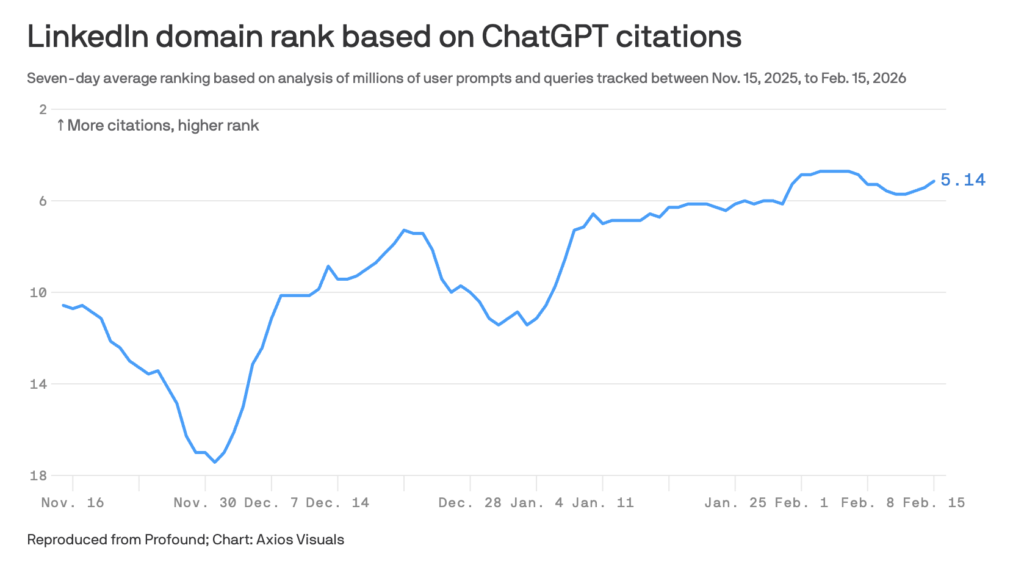
Why has LinkedIn become AI’s darling? The platform combines everything language models love: expert-authored original content, professional credibility signals like job titles and credentials, structured long-form articles easy to parse, and consistent publication of knowledge-driven material across professional topics. Microsoft’s infrastructure integration, Bing indexing and Azure AI services, likely amplifies LinkedIn’s presence in systems like ChatGPT and Copilot.
This fundamentally rewrites the rules of professional visibility. Traditional SEO focused on Google’s algorithm. Now, if you’re not creating content that AI systems cite, you’re invisible to a growing segment of information seekers.
The tactical implications are clear. Posts and articles between five hundred and two thousand words get cited most frequently. Practical knowledge and actionable advice perform best. Keyword-rich headlines with specific roles, skills, and measurable impact drive discovery. One career coach reported a client saw increased recruiter interest after replacing a generic marketing headline with specifics about fixing stalled sales pipelines after product launches.
For brands and executives, LinkedIn content is no longer just networking, it’s the new SEO battleground. Community and creator-driven platforms like Reddit, Wikipedia, and YouTube have emerged as top AI sources because they host genuine human insights. LinkedIn offers the same authenticity with professional context.
The bottom line? If your brand isn’t producing thoughtful LinkedIn content, you’re missing out on how professionals discover information in 2026.
Want to dominate LinkedIn and other digital channels? Partner with Donutz Digital.
Final Thoughts
This week’s themes connect in interesting ways. Customer confidence drives purchasing behavior. AI is reshaping the marketing profession. Brand value concentrates in tech giants. And content distribution is fundamentally changing through AI search.
What’s the common thread? Adaptation beats resistance. Markets reward those who understand shifts and adjust accordingly.
Until next week, keep questioning, keep testing, and keep building.
P.S. Need help navigating any of these trends? We’re a digital marketing agency specializing in SEO, paid social, and content strategy that actually works. Let’s chat.