
TikTok’s AI Remix Backlash, LinkedIn’s 5 Cs, YouTube Dominance
TikTok's AI privacy backlash, LinkedIn's 5 human skills to beat AI, YouTube's cross-gen dominance, and conversational search. Your weekly digital marketing briefing from Donutz Digital.
 Carla11 May 20269 min read
Hey there,
Welcome to this week’s Donut Break The Internet. We’ve got a spicy lineup covering TikTok’s AI privacy drama, LinkedIn’s advice for surviving the robot takeover, and YouTube proving once again that it owns every generation’s eyeballs. Let’s dive in.
TikTok’s AI Meme Maker Sparks Privacy Revolt
TikTok recently tested an experimental feature called Meme Remixer that turned every creator into unwitting AI training data. The platform quietly enabled a setting allowing viewers to generate AI images from video frames, think taking a still from your morning coffee routine and transforming it into a dancing cat meme. Sounds harmless until you realize it was switched on by default across every video you’ve ever posted.
Creators discovered the feature buried in privacy settings with zero advance notice. The backlash was swift and brutal. The main complaint was not just that TikTok enabled AI remixing without asking, it was that there was no account level opt out. If you wanted to protect your content, you had to manually disable the setting on every single video individually, including uploads from years ago. For creators with hundreds or thousands of posts, this felt less like a privacy control and more like a deliberate friction tactic.
TikTok defended the feature as experimental, available only to select users for testing. But the permission toggle appeared on everyone’s accounts, creating confusion about who could actually remix what. Within days, the platform paused the entire experiment following intense creator pushback and promised future versions would look very different.
The controversy highlights a pattern in social platform AI rollouts: move fast, apologize later, and hope users forget. For marketers, the lesson is clear. When platforms race to embed AI everywhere, creator trust becomes the real battleground. Your influencer partnerships and brand safety protocols need to account for these sudden policy shifts. AI features aren’t just tools, they reshape content ownership rules overnight.
LinkedIn Says Your Weird Human Traits Are Your Competitive Edge
While everyone panics about AI stealing jobs, LinkedIn’s leaders are making a different argument. In their new book Open to Work, CEO Ryan Roslansky and Chief Economic Opportunity Officer Aneesh Raman claim your competitive advantage against AI isn’t coding skills or technical prowess, it’s the messy human stuff that machines can’t replicate.
They call it the 5 Cs: curiosity, courage, creativity, compassion, and communication. AI can process patterns and calculate risk, but it can’t ask what if we tried something completely different or decide which risk is worth taking when the stakes are personal. It can’t read a room, earn trust, or lead through uncertainty.
The LinkedIn duo recommends breaking your job into three buckets. Bucket 1 holds tasks AI can do alone like data entry and basic research. These will disappear. Bucket 2 contains tasks you’ll do with AI, strategy backed by analysis, creative work assisted by tools. This is where most work is heading. Bucket 3 is purely human territory, building relationships, making judgment calls, leading teams through chaos. The goal is not protecting what’s in Bucket 1, it’s continuously moving toward Bucket 3 where durable value lives.
Your team’s ability to combine AI fluency with human judgment will determine whether you’re automating toward efficiency or automating toward irrelevance.
YouTube Owns Gen Z and Millennials, New Data Confirms
If you needed proof that YouTube is the internet’s town square, Precisify just handed it to you. Their new cross generational research shows YouTube is the only platform where Gen Z and Millennials consistently converge at scale, with 83% of Gen Z and 78% of Millennials using it regularly. That beats every other platform including TikTok, Netflix, and Instagram for sheer audience reach.
The data gets even more interesting when you look at ad performance. Over 50% of both age groups report strongest ad recall on YouTube, triple the rate for streaming services like Netflix. Nearly 45% of both generations spend between 30 and 60 minutes daily on the platform, with 11% watching over two hours. Millennials skew slightly higher on long form consumption, but the engagement patterns are remarkably similar across both cohorts.
What makes YouTube so dominant is its ecosystem effect. It’s not just short form or long form, it’s search, music, tutorials, entertainment, and creator culture all in one environment. For brands, this means YouTube offers something increasingly rare, efficient cross generational reach without platform hopping. You can build campaigns that span discovery, engagement, and conversion within a single interface.
The platform’s combination of scale, recall, and multi generational appeal makes it uniquely positioned for 2026 budgets, especially as fragmentation across TikTok, Instagram, and niche platforms continues to complicate media planning.
YouTube Tests AI Powered Conversational Search
YouTube is experimenting with Ask YouTube, a new conversational AI search feature that transforms the platform into something closer to an answer engine than a video library. Available to Premium subscribers in the US, the tool lets users ask complex questions in natural language and receive results combining AI generated text summaries, timestamped video segments, and both long form and Shorts content.
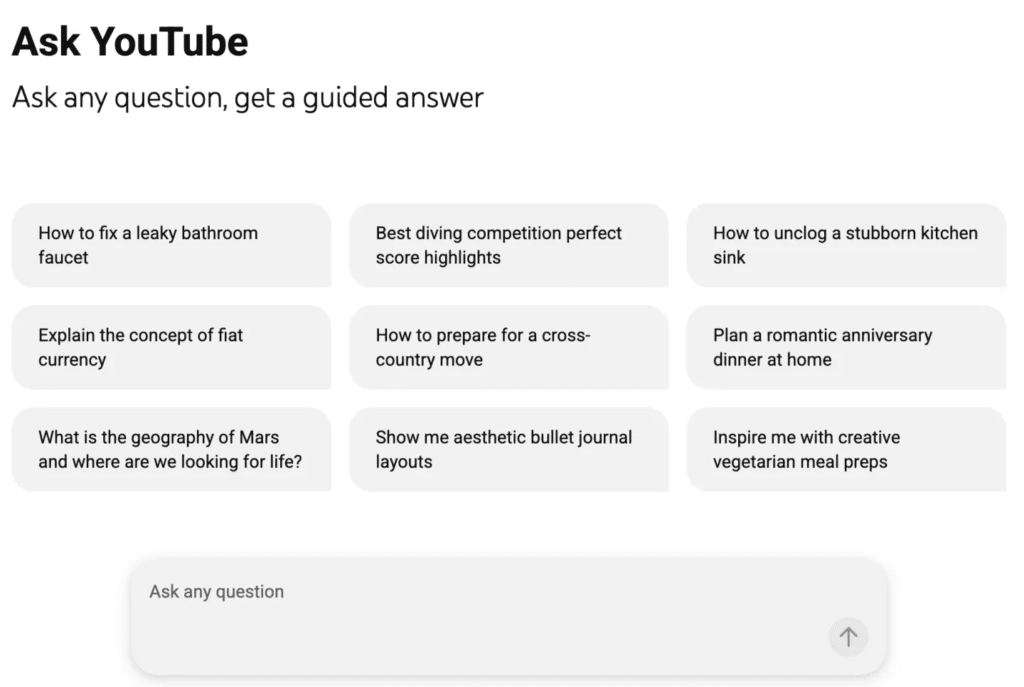
The interface feels like ChatGPT meets video search. You can ask plan a three day road trip from San Francisco to Santa Barbara and get step by step suggestions with embedded videos, then follow up with where can I get good coffee along the way and receive location specific recommendations. The AI cites its sources, linking directly to videos and highlighting relevant timestamps, making it easier to verify information and discover new creators.
Google is clearly racing to embed AI across its product suite as competitors like OpenAI and Perplexity build search experiences from scratch around conversational interfaces. YouTube represents Google’s most valuable content moat, with users spending an average of 48 minutes per day on the platform. Adding AI powered discovery could extend engagement and surface content that traditional keyword search would miss.
For marketers, this shift has major implications for video SEO and content strategy. If search behavior moves from keywords to natural language questions, your content needs to answer those questions explicitly. Think less about optimizing titles for algorithm keywords and more about structuring videos to provide clear, direct answers to common queries. The platforms that win in this AI search era will be the ones helping users find what they need faster, not just serving more impressions.
Wrapping Up
This week’s headlines tell a consistent story. AI is reshaping every layer of digital marketing, from content ownership and creator trust to search behavior and talent strategy.
If your marketing strategy needs a human touch backed by AI fluency, Donutz Digital is here to help.
See you next week,
The Donutz Digital Team
Ready to grow your digital marketing?
Get a free audit from our experts — no commitment.