
Gemini rises, OpenAI clicks, Meta automates, digital ads rewired
Google Gemini overtakes Perplexity, Meta pushes full automation, Apple launches privacy-first Maps ads, and OpenAI adds CPC pricing. Your weekly digest of digital marketing's biggest shifts.
 Carla27 April 202613 min read
Another week, another seismic shift in digital advertising. While you were busy optimizing campaigns, the platforms rewrote the playbook again.
Google’s Gemini just leapfrogged Perplexity in the AI referral race. Meta’s pushing full automation whether brands are ready or not. Apple’s bringing ads to Maps with a privacy twist that could redefine local targeting. Google’s finally streamlining enhanced conversions (only took them long enough). And OpenAI are now charging per click on ChatGPT ads, because apparently every platform wants a piece of your budget.
Here’s what you need to know to stay ahead.
Google Gemini Quietly Surpasses Perplexity in Bot Referral Traffic 🚀
The AI chatbot pecking order just shifted. Google’s Gemini has claimed the number two spot in global referral traffic, overtaking Perplexity for the first time. ChatGPT still dominates with a commanding 78% share of all chatbot-driven website visits, but Gemini has surged from a modest 2.3% in April 2025 to 8.65% this March, nearly quadrupling its presence in a year.
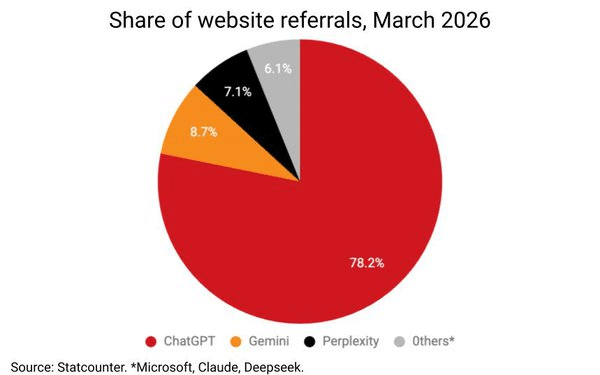
Perplexity, meanwhile, has slid from 12% to just 7%, marking a dramatic 40% decline from its peak. The shift reflects Google’s ecosystem advantage: Gemini is now woven into Search, Android, Workspace, and Chrome, turning these touchpoints into referral engines. For brands, this matters because chatbot referrals represent high-intent traffic users clicking through from AI responses convert roughly twice as well as standard organic search visitors.
Microsoft Copilot trails at 3.2%, while Anthropic’s Claude has quietly doubled its share to 2.9% in a single month. That spike followed widespread reports of users switching from ChatGPT, though weekly data suggests the surge was partly news-driven and may not stick. DeepSeek, despite headlines, barely registers at 0.02%.
What this means for CMOs: chatbots are no longer experimental discovery channels, they’re becoming critical referral sources. As AI transitions into a primary “discovery engine,” brands need to think beyond traditional SEO and start optimizing for how their content surfaces in conversational interfaces. The rules of visibility are being rewritten, and early movers have the edge.
Meta’s AI Ad Automation Faces Brand Pushback
Meta wants to make advertising as simple as handing over a credit card and a business goal, then letting AI handle everything else. The company has reportedly told investors this vision could arrive by late 2026. But marketers are pumping the brakes, and their hesitation reveals deeper tensions in the industry’s rush toward full automation.
Meta’s Andromeda ad retrieval system, rolled out since late 2024, has fundamentally changed how ads are matched to users. Instead of targeting fixed campaigns to narrow segments, the system now favors broad audiences paired with diverse creative content, using AI to determine which messages resonate with different users in real time. This shift incentivizes producing far higher volumes of creative assets. One agency exec recounted a recent client project that ballooned from 300 to 1,000 unique creative assets once personas and concepts were fully mapped out.
Yet while the platform pushes automation, brands are wary of relinquishing creative control. Most big advertisers refuse to let Meta’s AI generate or significantly alter their visuals, legal risks from undisclosed image generation and brand consistency concerns are top blockers. Even “low-risk” tweaks like contrast adjustments or overlays get vetted carefully. One media director noted feeling pressure to adopt at least some Advantage+ features to avoid perceived performance penalties, though Meta insists opting out doesn’t hurt delivery.
Performance gains from non-creative automation tools are real but directional, not gospel. AI-generated creative from Meta’s tools consistently underperforms compared to third-party systems tailored to specific brand guidelines, per multiple agencies. And Advantage+ campaigns, while accounting for 60-70% of some agencies’ Meta spend, still struggle with overspend on low-quality placements and poor demographic targeting.
Automation is useful, but the “credit card and business goal” future is further off than Meta’s timelines suggest. Human oversight remains essential, not just for creative, but for budget discipline and strategic coherence. Agencies that lean too far into black-box automation risk sacrificing brand integrity for marginal efficiency gains.
Working with a digital marketing agency that understands when to automate and when to keep humans in the loop? That’s us.
Apple Maps Enters the Ad Game
Apple is launching ads in Maps this summer across the US and Canada, and the move signals a fresh battleground in local advertising. Unlike Google, which has dominated Maps ads by leveraging user data, Apple is taking a privacy-first approach: no personal profiles, no precise location history, no cross-account tracking. Targeting happens purely in the moment, based on the current search query, approximate location, and what’s visible on screen.
This contextual model shifts the game from targeting people to targeting moments. Marketers will need to prioritize relevance, proximity, and timing over traditional audience segmentation. That’s a significant departure from how most digital advertising works today, and it raises the stakes for real-time decisioning and local inventory management.
Apple is also introducing “Suggested Places,” a new section that surfaces trending nearby businesses alongside explicit search results. This transforms Maps from a pure navigation tool into a discovery surface, where users can be influenced without actively searching. For brands, that’s an opportunity to shape decisions at the moment they matter most, right before someone heads out the door.
The new ads sit within Apple Business, a unified platform that combines brand management, device tools, and advertising in one interface. Small businesses benefit most from automated campaign creation that lowers entry barriers, though it also compresses the role of agencies into strategy and creative rather than execution.
Privacy constraints will shape how performance is measured. Attribution will be more aggregated, focusing on trends rather than individual user tracking. That limits precision but may deliver clearer signals about real-world actions like store visits and reservations, metrics that matter more than clicks when you’re trying to drive foot traffic.
The big question: can Apple maintain its premium user experience while balancing organic relevance and paid placement? If users start to feel Maps has become cluttered or overly commercial, adoption could stall. But if Apple executes cleanly, this could open a meaningful new channel where discovery happens in real time and decisions are made within seconds of action.
Google Streamlines Enhanced Conversions
Google is cleaning up one of its most-used measurement tools by consolidating enhanced conversions for web and enhanced conversions for leads into a single feature. Starting in June, advertisers won’t need to choose between implementations or toggle separate settings, just one unified on/off switch. It’s a small change with big implications for teams managing complex conversion setups across campaigns.
The update also allows multiple input methods to run in parallel. Advertisers can now send user-provided data through website tags, Data Manager, and API integrations simultaneously, rather than relying on a single source. More signals mean better matching, which improves accuracy and bidding performance, critical as traditional tracking signals degrade.
For most teams, the operational impact is minimal but meaningful. Existing users who’ve accepted Google’s customer data terms will be automatically migrated. New users can enable the feature at either the account level or per conversion action, with opt-out still available for granular control. The goal is to reduce setup friction without removing flexibility.
Google is betting that making enhanced conversions easier to implement will drive broader adoption, which in turn strengthens the data feeding its optimization systems.
Bottom line: if you haven’t enabled enhanced conversions yet, June’s update removes another excuse. And if you’re already using it, the streamlined setup means fewer moving parts to manage and more confidence that your data is flowing where it needs to go.
OpenAI Adds Cost-Per-Click Pricing to ChatGPT Ads
OpenAI has rolled out cost-per-click (CPC) pricing for ChatGPT ads, giving advertisers more control over how they’re charged. Until now, ChatGPT ads operated on a cost-per-view model, where brands paid for impressions. The new CPC option lets marketers optimize campaigns around clicks instead, setting maximum bids and providing “context hints” to guide which queries trigger their ads.
It’s a necessary evolution. Advertisers have been hesitant to shift budget from Meta and Google toward OpenAI partly because early ChatGPT ads offered minimal performance data, making it tough to justify the reallocation. CPC pricing won’t solve that entirely, but it aligns ChatGPT ads more closely with established digital advertising workflows, where clicks are a standard currency.
OpenAI is also working on campaigns focused on specific actions, app downloads, purchases, though timelines for that rollout remain unclear. The company has set aggressive revenue targets: $2.4 billion in ad revenue for 2026 and $11 billion by 2027. To hit those numbers, it’ll need to convince marketers that ChatGPT ads deliver not just reach, but measurable outcomes.
The ad industry is racing to build infrastructure for AI-related disruptions before autonomous agents start controlling media budgets. The Ad Context Protocol, for instance, is emerging as a standard for AI agents to communicate with publishers and ad platforms via machine-readable interfaces. Visa has debuted tools to support agent-driven commerce, while Google champions its Model Context Protocol servers for verified data retrieval.
OpenAI’s CPC launch is less about innovation and more about table stakes, getting ChatGPT ads to a baseline level of functionality that lets marketers experiment with confidence. If the platform can prove it drives meaningful conversions, it’ll carve out a slice of budgets currently locked up in Meta and Google duopolies. If not, the lofty revenue forecasts will remain just that: forecasts.
The Bottom Line
This week’s news tells a clear story: the platforms are consolidating power while simultaneously fragmenting the ad ecosystem. Google tightens its grip with Gemini’s ecosystem integration. Meta pushes automation that most brands aren’t ready to trust. Apple carves out a privacy-first niche in local ads. OpenAI tries to elbow its way into budgets with CPC pricing that should’ve launched six months ago.
The strategic imperative is simple but not easy: you need to move faster than the platforms change the rules. That means testing new channels before they mature, questioning automation that promises miracles, and building measurement infrastructure that works across an increasingly fragmented landscape.
Need a partner who keeps up with the chaos so you don’t have to? Donutz Digital helps brands navigate platform changes, optimize across channels, and turn industry turbulence into competitive advantage. Let’s talk strategy.
That’s it for this week’s Donut Break The Internet. See you next week with more insights and fewer headaches.
Ready to grow your digital marketing?
Get a free audit from our experts — no commitment.