
AI Shopping, Brand Identity Myths, and the Future of Social Commerce
Discover the latest digital marketing trends: Reddit's AI shopping tool, why brand colors don't create uniqueness, Gen Z's shift to Roblox commerce, and Meta's new engagement metrics.
 Carla20 March 202615 min read
This week brought major announcements that will reshape how brands approach e-commerce, measurement, and brand building. From Reddit’s entrance into AI-powered shopping to Meta rewriting the rules of attribution, these developments signal fundamental shifts in how consumers discover and purchase products online.
Let’s break down what these changes mean for your marketing strategy.
Reddit’s AI Shopping Assistant Has Entered the Chat
Reddit just rolled out an AI-powered search tool that turns community recommendations into shoppable carousels, positioning itself to compete with TikTok and Instagram in the commerce race.
The platform is testing this feature with a small group of U.S. users who’ll see interactive product displays complete with pricing, images, and direct purchase links when they search for things like “best noise-canceling headphones” or “electronic gift ideas for a college student.” The AI pulls products directly from Reddit discussions and matches them with retail partners, essentially monetizing the goldmine of authentic user recommendations that already exists in threads across the platform.
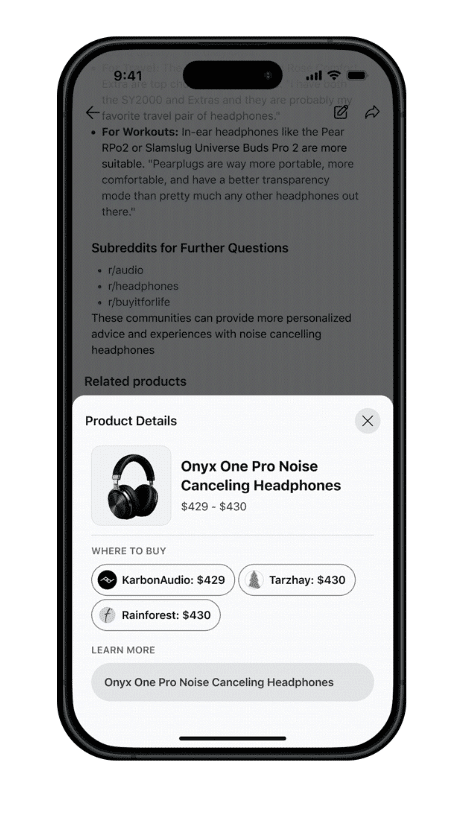
This move reflects Reddit’s broader push to blend community-driven content with commerce capabilities. Last year, they launched Dynamic Product Ads (personalized product recommendations based on user interests) and now they’re doubling down on shopping integration. The company is clearly trying to capitalize on what makes Reddit unique: real people sharing honest opinions about products they actually use.
According to Reddit CEO Steve Huffman, AI search represents the next major revenue opportunity for the business. The numbers back up that confidence: weekly active users for search jumped thirty percent over the past year (from sixty million to eighty million), while their AI-powered Reddit Answers feature saw explosive adoption, growing from one million weekly users in Q1 2025 to fifteen million by Q4.
The timing makes sense. While TikTok and Instagram have long dominated social commerce, Reddit is betting that authenticity wins. Unlike influencer-driven recommendations on other platforms, Reddit’s strength lies in unfiltered community discussions where users debate the pros and cons of products without branded partnerships clouding their judgment.
Reddit isn’t alone in exploring AI-driven shopping. OpenAI’s ChatGPT introduced an instant checkout feature last September for Etsy and Shopify purchases. But Reddit has something those competitors don’t: millions of existing product discussions that can be mined for genuine recommendations.
The takeaway? If you’re not already thinking about how your products are discussed in Reddit communities, now’s the time to start listening. Those organic conversations are about to become purchase pathways.
Your Brand Color Isn’t as Unique as You Think
Turns out picking the perfect brand color won’t make you memorable, but a distinctive mascot or logo absolutely will.
Research from the Ehrenberg-Bass Institute analyzed over twelve hundred brand identity elements across nineteen countries and found that people are twice as likely to correctly remember logos and mascots compared to colors. Even more revealing: eighty-two percent of color assets were associated with multiple brands, making color the least unique brand element you can choose.
The study examined consumer packaged goods categories and measured which brand elements created the strongest unique associations in people’s minds. Mascots and characters (think M&M’s characters or Colonel Sanders) performed best, followed closely by logos (like Nike’s swoosh) and distinctive fonts (Coca-Cola’s cursive script). Colors, despite being the easiest element to implement, consistently underperformed.
This happens because our brains process visual elements more easily than text-based ones, helping us instantly connect distinctive assets to brands. However, colors are frequently shared between brands and across categories, making them less effective for creating unique brand associations. When you think “bright red,” does your mind go to Coca-Cola, Netflix, YouTube, Target, or any of the dozens of other brands using similar reds?
The solution isn’t to abandon color altogether; it’s to use it strategically. Create unique color combinations (like Cadbury’s purple paired with gold accents) or combine your colors with unique shapes and patterns to develop a more distinct brand look. The key is layering multiple distinctive elements rather than relying on a single color to do all the heavy lifting.
For brands refreshing their identity or launching new products, this research suggests investing in memorable visual elements that genuinely differentiate you. A well-designed mascot or a proprietary font will serve you far better than simply choosing an “ownable” color from the Pantone book.
The bottom line? Stop obsessing over whether your shade of blue is slightly different from your competitor’s. Instead, focus on creating visual brand elements that are genuinely distinctive and consistently recognizable across touchpoints.
What Really Makes Your Brand Memorable?
Brand Element Effectiveness Ranking
Gen Z Is Shopping on Roblox More Than You’d Expect
TikTok Shop might dominate headlines, but Roblox is quietly emerging as a serious e-commerce contender for Gen Z, and its growth rate is crushing TikTok’s.
Data from the Retail Technology Show surveyed one thousand Gen Z shoppers and revealed they made an average of twenty purchases on Roblox within the last twelve months. That represents a fifty-four percent year-over-year increase from 2025. Meanwhile, Gen Z made an average of twenty-three purchases on TikTok during the same period, but that only reflects a ten percent growth rate.
While TikTok still edges out Roblox in total purchase volume, the momentum tells a different story. Roblox’s commerce growth is accelerating while TikTok’s is plateauing, suggesting younger consumers are increasingly comfortable spending money in gaming environments.
The platforms target fundamentally different shopping behaviors. Roblox primarily sells digital items like avatar skins and in-game accessories to gamers, while TikTok offers a vast marketplace of physical products from snacks to cosmetics to luxury handbags. However, Roblox recently launched integrations with Shopify and expanded into physical product licensing, blurring the lines between digital and physical commerce.
What makes Roblox’s commerce engine particularly interesting is its foundation in peer-to-peer engagement and community-driven discovery. Unlike TikTok’s algorithm-driven product recommendations, Roblox commerce happens within social gaming experiences where friends influence each other’s purchases organically.
The study also tracked Whatnot, a livestream shopping platform that saw first-time buyers grow three hundred seventy-four percent in 2025. Gen Z’ers make an average of sixteen orders per year on Whatnot, with women’s fashion streams now generating over five hundred thousand view hours monthly.
What this means for brands: If you’re targeting Gen Z, diversifying beyond traditional social commerce platforms isn’t optional anymore. The next generation of consumers is already comfortable making purchases in gaming environments and livestream shopping experiences. If your brand isn’t exploring these emerging channels, you’re missing where your audience is already spending money.
Meta Just Redefined How We Measure Social Engagement
Meta is changing how it reports click-based attribution, and it’s a direct challenge to Google’s dominance in measurement standards.
Starting later this month, Meta advertisers will see a new “engage-through attribution” category that captures social media-specific interactions like shares, likes, saves, bookmarks, and comments separately from traditional click-through metrics. This fundamentally changes how marketers measure the impact of social campaigns.
Previously, Meta used click-through attribution borrowed from the search advertising playbook, essentially playing by Google’s rules because those were the industry standard. But Meta argues that social media has surpassed search as the leading channel for ad spend, and deserves its own measurement framework that reflects how people actually engage with social content.
Under the new system, only direct link clicks that send users to an advertiser’s page will count as click-through attribution. All other social engagement actions (the shares, saves, and comments that drive downstream conversions) will be categorized as engage-through attribution. Advertisers can still use view-through attribution if they prefer to measure based on impressions.
This change addresses a longstanding frustration for social media marketers: social engagement that drives conversions often went uncredited in Google Analytics because it didn’t fit neatly into the click-through model. Someone might save your Instagram post, share it with a friend, and that friend later searches for your brand on Google, but traditional attribution gave Google all the credit.
Meta’s new definitions will align more closely with Google Analytics’ definition of clicks (which only counts clicks leading directly to landing pages) while creating a separate bucket for social-specific engagement that drives brand discovery and consideration.
This move also positions Meta to compete more effectively against incrementality measurement and media mix modeling, which have become the dominant attribution philosophies. Meta and Google have both launched their own MMM solutions (Meta’s Robyn and Google’s Meridian) that unsurprisingly excel at measuring activity within their respective ecosystems.
Why this matters: For marketers running cross-platform campaigns, this change means you’ll finally get clearer visibility into how social engagement translates to business outcomes. Just don’t expect the platforms to make it easy to compare apples-to-apples across Google and Meta anytime soon.
What This Means for Your Marketing Strategy
These four developments share a common thread: the digital marketing ecosystem is maturing beyond borrowed models and generic approaches. Reddit is carving out its own commerce identity based on authenticity. Brand research is debunking oversimplified assumptions about visual identity. Gen Z is demonstrating that commerce happens wherever community exists. And Meta is finally creating measurement frameworks designed for social, not search.
The winners in this evolving landscape will be brands that recognize these shifts early and adapt their strategies accordingly. Whether that means participating authentically in Reddit communities, investing in distinctive brand assets beyond color, exploring emerging commerce platforms like Roblox, or rethinking attribution models to capture the full value of social engagement, the opportunity is clear.
The digital marketing landscape isn’t just changing; it’s fragmenting into specialized channels with their own rules, metrics, and consumer behaviors. Success requires moving beyond one-size-fits-all strategies and embracing platform-specific approaches that respect how users actually engage with content and make purchase decisions.
At Donutz Digital, we help brands navigate these shifts with data-driven strategies that deliver real results. Whether you need expert management of your Google Ads and Meta campaigns, creative assets that convert, or strategic guidance on emerging platforms, we’re here to help you stay ahead of the curve.
Ready to level up your digital marketing? Let’s talk about growing your business together.
Ready to grow your digital marketing?
Get a free audit from our experts — no commitment.